CTSFD
All collections
Early Beta: Collections are in active development. Please report any bugs or feedback on Discord.
Dahen's WW2 Tanks LARPs
dahensalt · Public · 23 items · Created Aug 13, 2026 · Updated Aug 18, 2026

A Collection of WW2 Tank LARPs, with the goal of creating LARPs that represent their real-life counterparts as close as possible, balancing between looks and performance.

Please note that all the tanks here are ones that were fully built and functional during or before WW2. (Upto 2nd September 1945) This means no blueprint tanks, wooden mockups or incomplete prototypes.

Tanks are taken from my Larp List, though I didn’t create all the builds here. If you wish to discuss the larps with me, I have linked the list and the Tanmk Server Thread below:

https://docs.google.com/spreadsheets/d/1KO2cMOlW9_kD_8GliWoKU4o5L3Szh0RPiMd-xQtIxg8/edit?usp=sharing

https://discord.com/channels/1068662797648547911/1473474947618963548

net 3
Tanks of the United States of America
9
hull
turret
gun

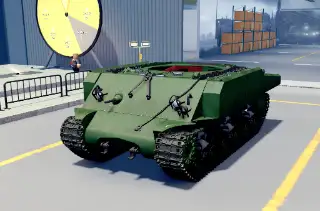
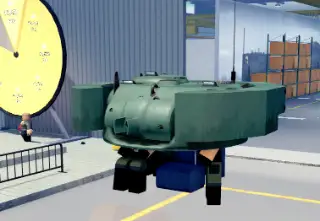
75mm GMC M8A1

Can Opener Historical Overview: Attempts by the US to create a 75mm armed light tank were not particularly successful, with the M7 being too heavy, and the T21 at risk of going down the same path, it was decided to create an expedient design on a preexisting, reliable, standardised chassis to keep weight down. For this, the M3 or M5 was selected. To test if mounting the 75mm M3 onto an M3 or M5 chassis, the order was given in late 1942 to install it into the turret of the M8 HMC. Several modifications were made in order to accommodate the larger gun. Both the Armoured Force and Tank Destroyer boards evaluated the M8A1, finding numerous deficiencies, such as a two-man turret, mediocre accuracy, unsatisfactory ammunition stowage and poor ergonomics. Both branches declared it unfit for service, especially as it was inferior to both the M24 Chaffee and M18 Hellcat, both of which were well into their development cycles. Source s : Tank Encyclopedia - 75mm Gun M3 on 75mm HMC M8


Larp Tier 3-4
no rating
hull
turret
gun

M8 HMC "Scott"

Beam me up, Scotty Historical Overview: In the late 1920s, the US Army introduced the 75 mm M1 Pack Howitzer into service. This lightweight weapon was intended to provide fire support to highly mobile units, such as paratroopers and marines, who could not easily transport heavy artillery. Even so, the US military wanted to create a self-propelled howitzer using the 75mm M1. Over several years, they would attempt to do so, but with little success, starting on the T1 Light tank, and some attempts on the M3 Stuart. There were several major design flaws with previous projects; the howitzers were mounted with limited traverse, fully-enclosed superstructures provided minimal working space for the crew, and the barrel itself was vulnerable to damage. The T47 solved these problems by introducing a large, fully traversable, open-topped turret. Initially the M3 hull was considered, but the M5 was chosen as it was more capable and was entering production. Source s : Tank Encylcopedia - 75mm HMC M8

Larp Tier 3
no rating
hull
turret
gun

Light Tank M5A1 "Stuart"

Stuart Little the 2nd Historical Overview: The core reason behind the development of the M5 was probably the rapidly growing demand for radial engines, which were in short supply in 1941, thus, other sources were approached in order to keep the Stuart in production. In June, the installation of twin Cadillac engines, a Hydramatic, and auxiliary transmission was approved, increasing the weight by 1.1 tons, but preserving its performance. It was also easier to start and maintain, was quieter and made the tank more roomy. The new tank was designated M4, and was combined with the M3A1E1 - a prototype testing a welded hull, to create the M3E2, then the M3E3. Among other modifications, the frontal plate was moved forward to free up space inside, and two rotating hatches with periscopes were fitted on the flat section behind the glacis for the driver and the bow gunner. To avoid confusion with the M4 Sherman, it was renamed to “M5”. Source s : https://tanks-encyclopedia.com/ww2/us/m5 stuart.php

Larp Tier 2-4
no rating
hull
turret
gun

Light Tank M3A1 "Stuart"

Honey Historical Information: Observing events in Europe and Asia during WW2, American tank designers realised that the M2 Light Tank was becoming obsolete and set about improving it, thus creating the M3 Light Tank. It had heavy armour for a light tank of the time, and improved suspension and recoil systems over the M2. Initially armed with a 37mm M5 gun and five M1919A4 Brownings, this was later rationalised to three machine guns and the slightly longer 37mm M6. The M3 Stuart action in every major theatre of the war, from North Africa, The Eastern Front, The Pacific and in Europe. Compared to similar tanks of the time, it was superior on paper, but a few deficiencies helped to hold it back; its turret could only house two men and it’s operational range was comparatively low. In Russian hands though, it was considered to be under-armoured, under-gunned, too sensitive to fuel quality, likely to catch fire, and prone to getting stuck in mud. Source s : https://en.wikipedia.org/wiki/M3 Stuart

Larp Tier 2-3
no rating
hull
turret
gun

T7 Combat Car

He is Speed Historical Information: In November 1936, the US Army’s Cavalry Branch decided to modernise and needed a fully armoured vehicle, capable of fulfilling regular combat duties. As they were prohibited from using “tanks”, the term “combat car” was used as a legal loophole to bypass the National Defence Act of 1920. Between 1937 and 1938, the Rock Island Arsenal developed and built the T7 Combat Car. It was based on the chassis of the M1 Combat Car - the hull lengthened and given convertible suspension, allowing it to run without its tracks, theoretically making it highly versatile. However, its armament was quite lacking, being only a single 12.7mm M2 Browning and three 7.62 M1919 Brownings, making it only useful against infantry and thin-skinned vehicles. The only prototype was sent to Aberdeen Proving Grounds in August 1938, showcasing it’s high speed and good performance, US Cavalry representatives though, weren’t impressed. Source s : https://en.wikipedia.org/wiki/T7 combat car

Larp Tier 1
no rating
hull
turret
gun

T3 Convertible Medium Tank

Fast And…Still Feeble? Historical Information: On November 19th, 1928, an unusual vehicle came out of Fort Meade in Maryland. It looked more like a race car than what it really was: a tank. This was the Christie M.1928, an experimental vehicle built by John Walter Christie's new company, the US Wheel Track Layer Corporation. Christie called his brainchild "M.1940", implying that this was a design ahead of its time. While two M.1940s were being shipped off to the Soviet Union, the factory was hard at work on the tank meant for the Ordnance Bureau. The turret was not produced in time for trials and would begin them without it. On January 22nd, the tank was shown off in all its glory in front of the factory in Rahway with many journalists present. The tank easily crossed various obstacles, climbed steep hills, and demonstrated excellent mobility. It had a proper turret with a 37 mm M1916 gun and a Browning M1919 machine-gun. Source s : https://www.tankarchives.com/2016/11/christie-m1931.html

Larp Tier 1
2.7 (3)
hull
turret
gun

T1 Combat Car (USA W.404)

Fast And Feeble. Historical Information: On November 19th, 1928, an unusual vehicle came out of Fort Meade in Maryland. It looked more like a race car than what it really was: a tank.This was the Christie M.1928, an experimental vehicle built by John Walter Christie's new company, the US Wheel Track Layer Corporation. Christie called his brainchild "M.1940", implying that this was a design ahead of its time. The US Wheel Track Layer Corporation was working on four tanks for the cavalry. These tanks were indexed Combat Car T1. There was not enough armament for every tank, and one of them serial number USA W.404 was lacking not only a gun, but a gun mantlet. It was equipped with a 12.7 mm Browning M1918 aircraft machine-gun. A photograph of the tank perpetrated the myth that the Combat Car T1 had different armament than the Convertible Medium Tank T3. In reality, the cavalry tanks had identical armament to their infantry brothers. Source s : https://www.tankarchives.com/2016/11/christie-m1931.html

Larp Tier 1
2.5 (2)
Tanks of the UK and Commonwealth
3
hull
turret
gun

AEC Armoured Car Mk.I

Valentine on wheels Historical overview: AEC of Southall were a bus and truck company, and its Matador artillery tractor was used as the basis of their new, private-venture armoured car. It was designed to be as well armed, and armoured as current Cruiser tanks in use by the army, and the frontal plates being well sloped helped to that end, though the same could not be said elsewhere on the tank. It was quite roomy by armoured car standards, and initially being equipped with a Valentine Mk.II’s turret and OQF 2-Pounder gun gave it adequate firepower and armour for an armoured car in 1942. It could also mount a Bren gun, or one or two Vickers K machine guns on the roof for anti-air capabilities or additional firepower against infantry, alongside the coaxially mounted BESA. A total of around 120-130 Mk.I AEC Armoured cars would be produced between 1941 and 1942. Source s : Wikipedia - AEC Armoured Car The World Wars.Net - AEC Armoured Car

Larp Tier 2
no rating
hull
turret
gun

AEC Armoured Car Mk.II

Speed Demon Historical Overview: AEC of Southall were a bus and truck company, and its Matador artillery tractor was used as the basis of their new, private-venture armoured car. It was designed to be as well armed, and armoured as current Cruiser tanks in use by the army, and the frontal plates being well sloped helped to that end, though the same could not be said elsewhere on the tank. The AEC Mk.II differed in many ways to its predecessor, most notably, the turret had changed to one resembling that of a Churchill Mk.III. It was armed with the powerful 6-Pounder gun, making it potent against most German armour at combat ranges, and the redesigned hull-front meant that it was better protected against incoming fire. It did however lose its capability to mount additional machine guns on the roof. Source s : Wikipeda - AEC Armoured Car The World Wars.Net - AEC Armoured Car

Larp Tier 3-5
no rating
hull
turret
gun

AEC Armoured Car Mk.III

Cromwheel but Real Historical Overview: AEC of Southall were a bus and truck company, and its Matador artillery tractor was used as the basis of their new, private-venture armoured car. It was designed to be as well armed, and armoured as current Cruiser tanks in use by the army, and the frontal plates being well sloped helped to that end, though the same could not be said elsewhere on the tank. The AEC Mk.III was virtually identical the Mk.II with only the gun being changed from a QF 6-Pounder to a QF 75mm, allowing it to fire more potent US 75mm HE shells, in exchange for slightly lowered armour penetration capabilities. It fought alongside the AEC Mk.II and T17 Staghound in Europe, replacing US-built 75mm armed Half-tracks in some armoured car regiments. Source s : Wikipedia - AEC Armoured Car The World Wars.Net. - AEC Armoured Car

Larp Tier 3-4
no rating
Tanks of the 3rd Reich
2
hull
turret
gun

Panzer IV F2/G (early)

Upgrades people, Upgrades! Historical Overview: Pre-war, the Role of the Panzer IV was to act as fire-support for weaker tanks and infantry, using the 7.5cm KwK.37 L/24, their primary targets were fortifications and MG nests, for which they were supplied a HE shell, which was also effective against armour of the time. However, in the mid 30s, Germany received reports of tanks protected by upto 40mm of armour, and so they would develop an AP shell that could punch through that at upto 700m away. However, by 1940 and 41 standards, this was quite anemic. And when it came to facing Soviet T-34s and KV-1s, it simply wasn’t enough, so multiple projects were started to create weapons capable of defeating such armour. One of these resulted in the PaK.40, which was then modified to fit into the Panzer IV turret, as the recoil was too great and the ammunition too long, both were rectified by March 1942, and the Ausf.G was born. Source s : TE - Panzer IV Ausf.G

Larp Tier 3-4
no rating
hull
turret
gun

Panzer IV Ausf.G/H

Panzer Vor! Historical Overview: With the introduction of the long barrelled 75mm KwK.40, the role of the Panzer IV shifted from mobile infantry support to being the back-bone of German armour during and after the middle stages of the war. In 1943, it was clear to German High Command that in order to make up for the losses suffered at the hand’s of the Soviets, production would need to be increased. The efforts bore small fruits, with Nibelungenwerke being able to increase production by 20 Tanks/month, however, this would later be stifled by reducing tank production in favour of StuG IVs and JPz. IVs. Further development of the Panzer IV led to the Ausf.H version. There is a misconception about the difference between it and the Ausf.G, commonly attributed to the barrel length. In reality, late production Ausf.G’s used the same KwK.40 L/48, and were identical to Ausf.H’s. One would be forgiven for asking “why bother changing the designation?”. Source s : TE - Panzer IV Ausf.H

Medium Tank Tier 4-5
no rating
Tanks of the Soviet Union
0

Empty folder.

Tanks of the Japanese Empire
9
hull
turret
gun

Type 97 Te-Ke Armoured Car

The Ribbon Warrior Historical Overview: The origins of the Type 97 lay in a prototype diesel-engine version of the Type 94 TK developed by Hino Motors in 1936. Although superior to its predecessor on paper, initial trials were not successful, and so changes were made. The design of the Type 97 became somewhat more traditional, with the engine in the rear, the turret in the middle, and the driver in front, offset to the left. This was accepted for service and entered production in 1938. It was armed with the same gun as on the Type 95 Ha-Go, a Type 94 37mm gun, though production shortages meant that it was also armed with a 7.7mm Type 97 as its primary weapon. Being designed as a reconnaissance vehicle, it was lightly armed and armoured, not intended for direct combat. Further more, its two-crew layout meant that the commander would have been highly overworked. Still, it’s service record was moderately successful. Source s : Wikipedia - Type 97 Tankette GUP Wiki - Type 97 Te-Ke

Larp Tier 1-2
no rating
hull
turret
gun

The Type 2 Ka-Mi was the first amphibious tank used by the Imperial Japanese Navy during World War II . Built by Mitsubishi starting in 1941, it was based on the Type 95 Ha-Go light tank. It featured a watertight hull and large, detachable front and rear pontoons for buoyancy during island landing operations. Detached pontoons

Light Tank Tier 2-3
no rating
hull
turret
gun

T2 Ka-Mi (With pontoons)

The Type 2 Ka-Mi was the first amphibious tank used by the Imperial Japanese Navy during World War II . Built by Mitsubishi starting in 1941, it was based on the Type 95 Ha-Go light tank. It featured a watertight hull and large, detachable front and rear pontoons for buoyancy during island landing operations. With pontoons

Light Tank Tier 2-3
no rating
hull
turret
gun

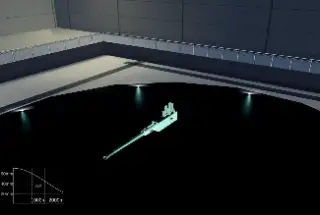
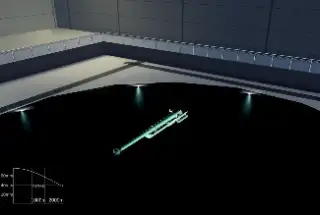
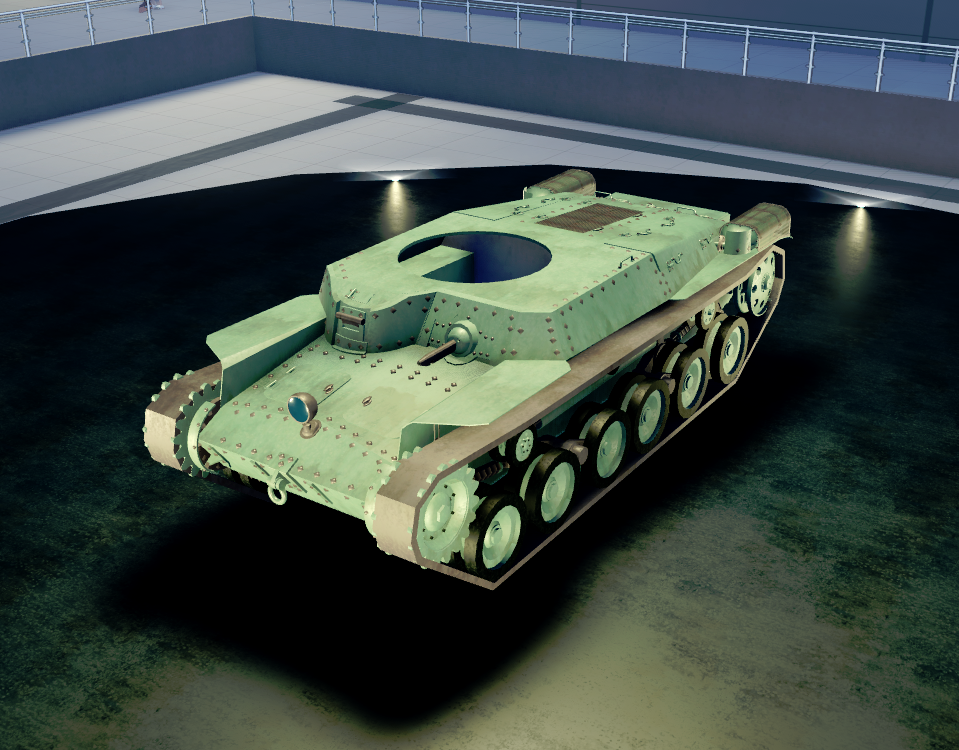
the Type 3 Chi-Nu was a World War II medium tank used by the Imperial Japanese Army . Designed in 1943 as an upgrade to the Type 1 Chi-He, it featured a powerful 75 mm main gun or 75mm type 3 in cts name, housed in a new hexagonal turret.

Medium Tank Tier 2
no rating
hull
turret
gun

Type 97 Ki-To SPAAG

Automatic Goober Historical Overview: With the introduction of the 20mm Type 98 AA gun in 1937, the decision was made to mechanise them to ease their deployment and otherwise aid the Army’s overall mechanisation efforts at the time. The gun was initially mounted on the Type 94 six-wheeled truck, similar to the ZIS-12 “Milk Truck”. Wanting to further these capabilities, the Army decided that the Type 98 should be mounted on a tracked chassis, increasing off-road mobility, for this the Type 97 Te-Ke was chosen. Modifications began somewhere between 1938 and 1941, with the hull lengthened, the turret and side-mounted muffler was removed, and an extra road wheel added. Despite these modifications, the Te-Ke's chassis limited the Ki-To’s potential to be an effective SPAA, a gun shield could not be added as it would block the Driver’s hatch or decrease crew space. What armour there was, was still minimal, and stability was understandably quite poor. Source s : WT Forums - The Ki-To

Larp Tier 3-4
no rating
hull
turret
gun

Type 95 Ha-Go (Mass Production)

Smol Samurai Historical Overview: In 1933, in Manchuria, Japan’s first mechanised corps was formed as an independent mixed brigade. Based on forces emerging in Europe, it was intended to operate independently or alongside larger forces. However the new corps highlighted an issue with Japan’s current battle tank, the Type 89, namely its leisurely speed of 25km/h. Work on a new, faster tank began in mid-1933, and a prototype was completed a year later, though it was slightly heavier than desired. A re-trial showed that it was capable of upto 45km/h and had good endurance. As the infantry branch were not quite satisfied with the tank, further modifications kept being made, resulting in its unique shapes, with one machine gun facing almost rearwards in the turret. Initially armed with a 37mm Type 94 L/36 and two 6.5mm Type 91 MGs, this was later upgraded to a slightly better 37mm Type 97/98 and 7.7mm Type 97 MGs, which is the version I intend to present here. Source s : TE - Type 95 Ha-Go

Larp Tier 1-2
no rating
hull
turret
gun

Experimental Type 3 Ke-Ri

A better supporter Historical Overview: Even from its inception in 1934, the Type 95 Ha-Go was considered under-gunned for infantry-support operations. Complaints from the Army’s Infantry Branch were probably tempered when Mitsubishi added a second machine-gun to the turret, but it seems that later in the war, the need for a more effective light, anti-infantry tank was revived. Thus, work began on improving the capabilities of the Ha-Go, most likely due to it being the IJA’s most abundant light tank, and the Type 90/97 57mm Howitzer was chosen for the armament. The Experimental conversion probably took place in 1943, or as late as 1944, but was rejected, as the larger gun likely took up too much space in the Ha-Go’s already cramped 1-man turret, reducing its effectiveness and further overworking the commander. This particular issue would later be fixed on the Type 4 Ke-Nu. Source s : Enlisted Forums - Type 3 Ke-Ri/Ke-Nu

Larp Tier 1-2
no rating
hull
turret
gun

Type 4 Ke-Nu

Japanese Goblin Historical Overview: Since the Ha-Go was still under-gunned after the failure of the Type 3 Ke-Ri, an attempt was made to rectify the issue of the turret being too cramped. The solution it seemed, was rather simple, instead of re-fitting the Ha-Go with just 57mm Type 90/97 gun, the engineers at Mitsubishi simply took the turrets of Old Chi-Ha’s and placed them onto the Ha-Go hull. Since the Chi-Ha had been designed around the 57mm in the first place, this solved the cramped turret issue, and came with the added benefit of improved turret armour. However, the weight would once again creep up as a result of this, from early prototypes weighing in at 6.5 Tons, to Production models coming in at 7.4 Tons, the Ke-Nu would become slightly overweight at 8.4 Tons, reducing its top speed from 45km/h to 40km/h. Around 100 Ha-Go’s would be converted to Ke-Nu's between 1944 and 1945, though would see limited action only in Manchuria. Source s : TE - Type 95 Ha-Go Wikipedia - Type 4 Ke-Nu

Larp Tier 1-2
no rating
Tanks of Fascist Italy & Minor Axis Nations
0

Empty folder.

Tanks of the Republic of France, & Western Aligned Nations
0

Empty folder.